Frequently asked questions
The grade, the label, the privacy of your code, the prices: answers to the questions we are asked most often.
What is Vybel?
Vybel analyzes the code of any website or app, whether it was written by hand, with AI (Lovable, Bolt, v0, Cursor, Claude Code…) or both, and gives it a grade from A to E across eight areas, which anyone can check without seeing the code. Every issue found is explained, with the files involved and a fix prompt to paste into your AI agent.
How is the grade calculated?
With fixed, public rules and no AI: the same code always gets the same grade. The full methodology, the Vybel Standard, details every rule and its weight.
Which standards is the grade based on?
On recognized standards: the OWASP Top 10 for security, the GDPR for personal data, the software quality characteristics of ISO/IEC 25010, the RGESN (Arcep, ADEME) for efficiency. And it is in line with the law: the French cyberscore (law of 3 March 2022) and the European Cyber Resilience Act (Regulation 2024/2847), fully applicable on 11 December 2027. The label replaces neither a security audit nor a conformity certification.
Is my code safe?
No code is executed. Files are analyzed, then deleted when the analysis ends, and dependencies (node_modules…) are never sent. For a private repository, Vybel reads only the repositories you choose on GitHub, read-only, and the report is visible only from the browser that ran the analysis (and from your Vybel Pro account, if you have one).
How much does it cost?
The analysis is 100% free, full report and prompts included. Analyzing a project again costs €5.99 excl. VAT, without creating an account, with the invoice sent by email. Vybel Pro costs €4.99 excl. VAT per month per labeled project, with access opening in waves from the waitlist: daily routine, Monday recap, live badge and two on-demand analyses a month, then €1.99 excl. VAT per analysis.
Which languages are analyzed?
Deep analysis covers JavaScript, TypeScript, Python, Rust, Go, Java, Kotlin, Swift, C#, C, C++, PHP and Scala; the import graph (dead code, circular or broken imports) covers JavaScript, TypeScript, Python and Rust. Other languages get the general rules: size, duplication, secrets, documentation.
How do I analyze a private repository?
Connect GitHub, GitLab or Bitbucket, then choose the repository to analyze: Vybel reads it read-only, and you can withdraw this access whenever you like. The repository is on another account? “Add another account” connects it too: several accounts of one host stay connected together. You can also drop the project folder or a .zip archive on the home page.
My repository is a monorepo: how do I analyze only the app, the site or the back end?
Paste the link to the folder (for example github.com/you/project/tree/main/apps/web): Vybel analyzes that folder alone, on that branch. For a connected repository (GitHub, GitLab, Bitbucket), click “A folder…” next to the repository: Vybel suggests the folders it finds there. Each folder is a project of its own, with its label and its free analysis; the lockfile, continuous integration and linter at the repository’s root count for it.
What is a verified label?
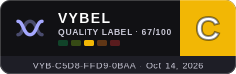
Every report carries a number and the analyzed commit: a recruiter, a customer, an investor or a buyer can check the grade on Vybel. With Vybel Pro, the verified owner of a repository displays a live badge, always up to date, on their website or README.
How do I improve my grade?
Start with the priorities of the report: every issue comes with a prompt ready to paste into your AI agent (Claude Code, Cursor, Codex…). Fix, then run the analysis again (€5.99 excl. VAT, or included in Vybel Pro).
Who is behind Vybel?
A team of experts: developers, DevOps engineers and artificial intelligence specialists, with years of experience. Vybel is published by OVO SAS, a French company.
How can I contact you?
Click “Any questions?” at the bottom right: the assistant answers right away, and the form reaches a person, who answers you by email.